Names We Call Home by Becky Thompson Sangeeta Tyagi
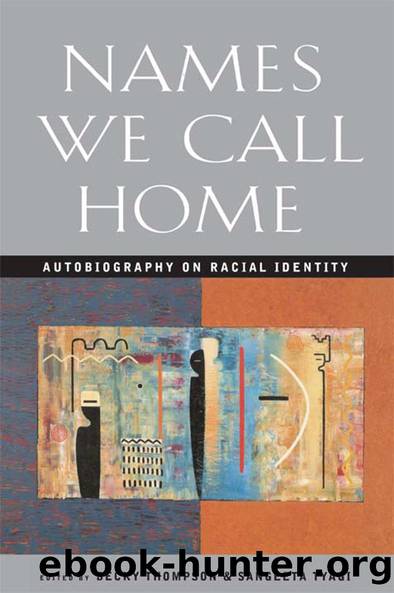
Author:Becky Thompson, Sangeeta Tyagi [Becky Thompson, Sangeeta Tyagi]
Language: eng
Format: epub
ISBN: 9780415911627
Barnesnoble:
Publisher: Taylor & Francis
Published: 1995-12-27T00:00:00+00:00
III
Who and what one becomes is a significant part of how one is perceived by the eyes of the world in which one is born and lives. We were made absolutely visible in and by the Jim Crow signs of âcoloredâ and âwhiteâ that were everywhere. We were forever under the white gaze from which there was no escape. Our ways and modes of living and expressing ourselves, which reflected our culture of origin in Africa, were degraded and denied. A black gospel quartet could perform in a white church, but no black people were permitted to enter. We stood outside on the Sunday afternoon sidewalk, degraded, yet proud because the singers were superb.
On the other hand, we were completely invisible, denied all but the most menial qualities in our own right. I do not remember that it ever occurred to me in a conscious manner that my childhood heroes in the comics were whiteâSuperman, Dick Tracy, Captain Marvel, and the âclassic comicsââJane Eyre, Oliver Twist, The House of Seven Gables. Straight through to the eighth grade, elementary, and high school, I do not recall any teaching about the history of Negro people. The important people in history were white men, George Washington, Abraham Lincoln, Benjamin Franklin, and even John Brown. The only black men we learned about were George Washington Carver, the scientist, who invented various products from peanuts and gave his for mulas to white men for nothing. The other black man was Booker T. Washington, whom white people liked very much, because Washington believed that Negroes should stay in their place. Only one woman was mentioned in history, a white women, Betsy Ross, who sewed the first American flag. I graduated from high school in the top of my class. 1 knew nothing about Frederick Douglass, Nat Turner, Sojourner Truth, Harriet Tubman, W.E.B. Du Bois, or the NAACP.
I heard about slavery from my grandmother, and perhaps she mentioned that we had all been brought originally from some faraway land called âAfrica,â where we were a proud people. But the black men and women I saw in the movies consisted of maids, mammies, servants, clowns, and buffoons who said âyessumâ and ânawsumâ to white folks and who rolled their eyes and ran from ghostsâButterfly McQueen, Hattie McDaniel, Mantan Moreland, Rochester, Stepin Fetchit.
My first image of Africa came from the Tarzan movies, in which the virile, macho white man, white boy, and white woman, lived in and ruled over the jungle, its animals and the âsavage natives.â The American Saga portrayed invincible white men called âCowboys.â There were super heroic role models like Randolph Scott and John Wayneâthe latter slaughtered thousands of âinjungsâ without reloading his rifle. There, in the atmosphere of the picture show, Chattanooga black boys and girls vicariously experienced what white men really thought of black men and women. We also watched and laughed at the manner in which white men portrayed white women. In the film series, âThe Perils of Pauline,â a fleshly, blond white
Download
This site does not store any files on its server. We only index and link to content provided by other sites. Please contact the content providers to delete copyright contents if any and email us, we'll remove relevant links or contents immediately.
Cecilia; Or, Memoirs of an Heiress — Volume 1 by Fanny Burney(32636)
The Great Music City by Andrea Baker(32609)
Cecilia; Or, Memoirs of an Heiress — Volume 2 by Fanny Burney(32010)
Cecilia; Or, Memoirs of an Heiress — Volume 3 by Fanny Burney(31996)
We're Going to Need More Wine by Gabrielle Union(19108)
All the Missing Girls by Megan Miranda(16317)
Pimp by Iceberg Slim(14666)
For the Love of Europe by Rick Steves(14579)
Bombshells: Glamour Girls of a Lifetime by Sullivan Steve(14137)
Norse Mythology by Gaiman Neil(13458)
Talking to Strangers by Malcolm Gladwell(13440)
Fifty Shades Freed by E L James(13291)
Mindhunter: Inside the FBI's Elite Serial Crime Unit by John E. Douglas & Mark Olshaker(9420)
Crazy Rich Asians by Kevin Kwan(9345)
The Lost Art of Listening by Michael P. Nichols(7548)
Enlightenment Now: The Case for Reason, Science, Humanism, and Progress by Steven Pinker(7354)
The Four Agreements by Don Miguel Ruiz(6835)
Bad Blood by John Carreyrou(6671)
Weapons of Math Destruction by Cathy O'Neil(6365)
